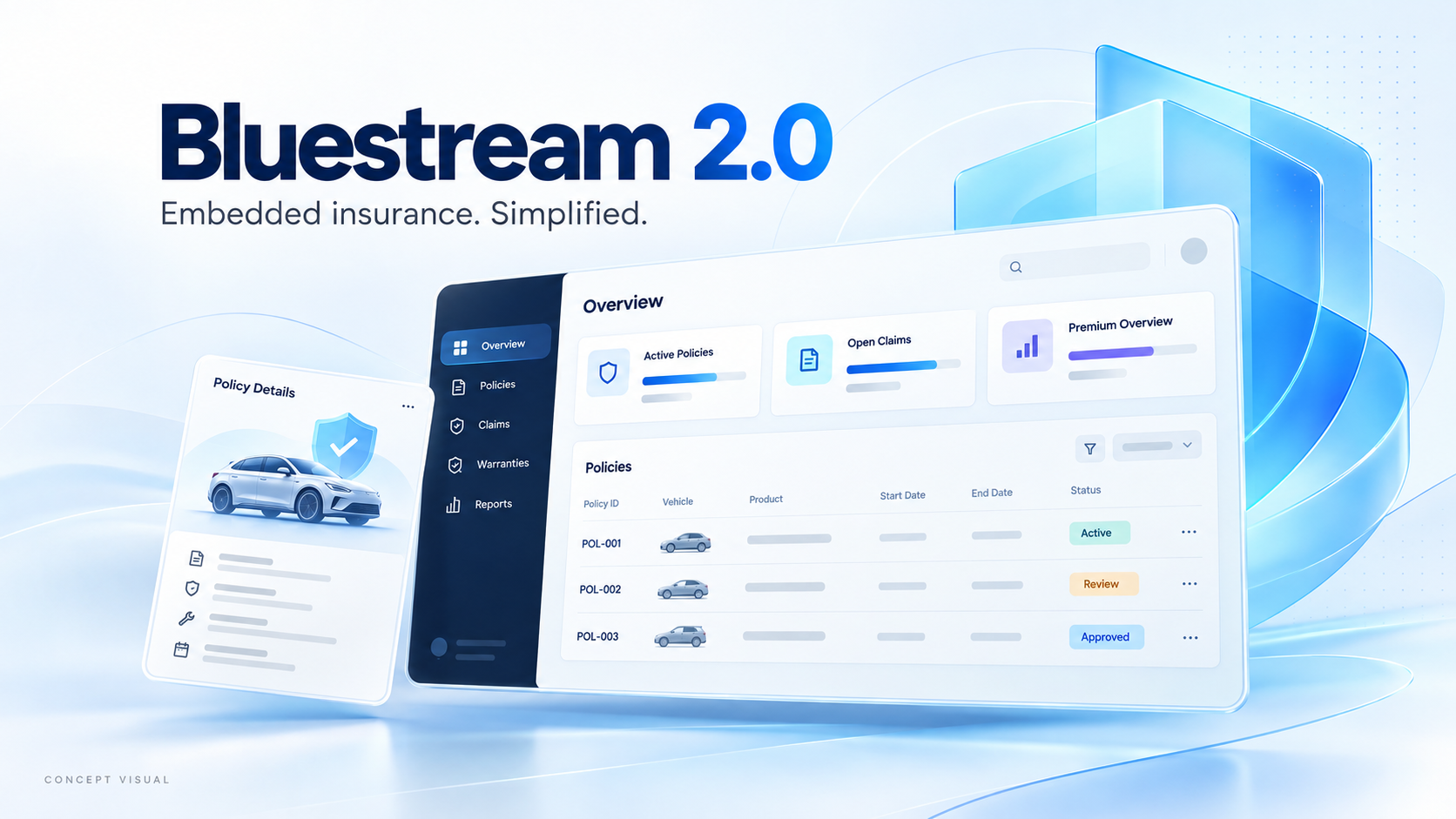
Bluestream 2.0
All case studiesInsurtech Platform

Bluestream 2.0

Modernized a global embedded-insurance platform serving Fortune 500 automotive clients (Tesla, BMW, Mercedes-Benz, Porsche), removing engineering as the bottleneck to growth.

+35%

Platform adoption

+50%

Operational efficiency

01

Overview

A global insurtech platform serving Fortune 500 automotive clients (Tesla, BMW, Mercedes-Benz and Porsche) was structurally limited in how fast it could onboard new business or adapt to client-specific needs. This case study covers the product decisions behind modernizing it.

02

Problem

The legacy platform relied almost entirely on bulk data uploads; even one policy addition meant running a full bulk-upload process. Claims and warranty workflows had no rule-based validation, so incomplete submissions made it through intake only to bounce back later. Every workflow change or client-specific configuration required engineering. The real cost wasn't any single broken workflow; the platform couldn't scale to new clients or rules without a development cycle attached to every change. My mandate: remove engineering as the bottleneck to growth.

03

Discovery & Customer Insights

I ran discovery sessions and legacy audits across 4 enterprise clients, surfacing 15+ workflow inefficiencies. A few patterns repeated:

  • Insurance reps absorbed the cost of incomplete claims, chasing missing information after submission because nothing validated it at intake.
  • Administrators and consultants couldn't make their own configuration changes; every customization routed through engineering.
  • Requirement clarity, not engineering capacity, was the real constraint behind missed release commitments.
04

Product Strategy

Discovery pointed to three root bottlenecks: policy-creation friction, claims rework from no intake validation, and configuration dependency on engineering. Rather than rebuilding everything, I prioritized the two with the highest compounding cost, claims validation and configuration dependency, and sequenced self-service policy creation alongside them since it shared the same UI investment. Advanced reporting, a frequent ask, was deliberately deferred because it didn't address the structural constraint on growth.

05

Solution

To break the engineering dependency directly rather than documenting around it, I drove two platform-level investments alongside the feature roadmap:

  • A reusable UI component library so future screens could be assembled from shared, pre-approved components.
  • Independent, decoupled Camunda workflow orchestrations so developers could reuse existing patterns instead of building new logic each time.
  • A single MoSCoW-prioritized roadmap aligning all 6 stakeholder groups, backed by 350+ user stories paired with BPMN decision models.
06

Execution

I partnered closely with the Figma design team, sharing the insurance domain knowledge they needed to design rule-compliant prototypes; one was selected by stakeholders and became the direction the team built toward. I co-designed the UAT strategy with QA, embedding acceptance criteria into testing so defects were caught against a shared definition of done.

07

Impact

Delivery, quality, business and adoption results:

+30%

Requirement clarity

-42%

Requirement defects

+25%

Sprint velocity

-20%

Post-production defects

+35%

Platform adoption

+50%

Operational efficiency

08

Business Outcome

Onboarding a new client, including Fortune 500 accounts like Tesla, BMW and Porsche, no longer required a multi-sprint development cycle; it became a configuration exercise business consultants could run themselves. Platform changes became deliverable on a sales-driven timeline instead of an engineering-driven one. The work earned the Client Excellence Award at Marsh McLennan, twice, in 2024.

09

Reflection

The biggest lesson was that the real constraint wasn't documentation quality; it was that the platform's architecture, not its process, capped growth. Better requirements would have helped; changing what the architecture made possible is what actually removed the bottleneck.

Downloads

One-pagers, PRDs and decks for this case study will be available here.

Attach downloadable files when ready.